
Knowledge Center
Searching for Samples
The NIAID Data Ecosystem contains millions of metadata records for biological samples, commonly called biospecimens. Users can search for samples available through dedicated sample repositories or find sample information associated with datasets.
How to find samples from dedicated sample repositories #
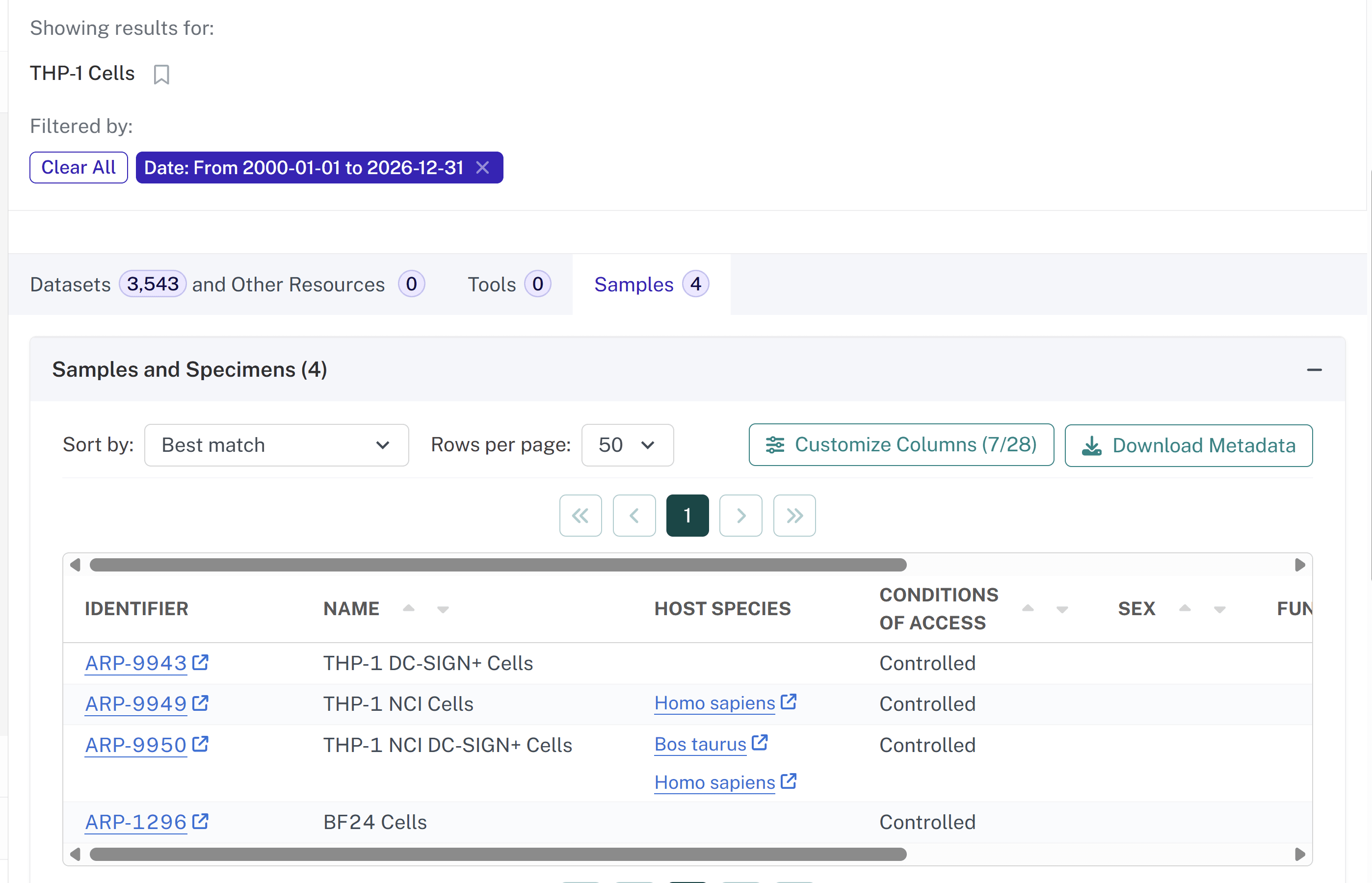
Start by entering a term in the search bar. If you enter a very specific query, for example, “THP-1 Cells”, you may find highly-relevant but few results.
If you enter a broader query, for example, “Malaria” with “Samples” selected for Type, you will get thousands of results and can narrow the results down using filters.
Some metadata fields are common across all resource types, such as Date, Health Condition, or Pathogen Species. There are additional sample-specific filters, which include: Anatomical System (e.g., Circulatory, Immune, etc.), Associated Genotype (e.g., WT, RNAse, etc.), Associated Phenotype (e.g., CD8+), Cell Type (e.g., CD4-positive, alpha-beta T cell, etc.), Instrument (e.g., qPCR, ELISA, etc.), Sample Type (e.g., DNA, LCL, etc.), and Sex (e.g., Male, Female, etc.).
You can customize the list of filters displayed to only show the filter properties you are interested in. To do this, click the button “Customize filters” at the top of the filters list.
You can customize the columns displayed to create a view of the most relevant metadata fields to you. Then, when you’ve found a sample of interest, you can use the sample metadata record to access it from the source.
How to find samples associated with datasets #
Samples associated with datasets are only visible through their associated datasets and are not included in the sample counts shown in the Samples tab. These include:
- Experimental Samples: Samples that have been processed and used to generate a dataset
- Population Samples: Aggregate sample information, generally associated with clinical datasets in which individual sample record information are not available
Search for a dataset, click on it, and navigate to the Samples section of the metadata record. You can search across Experimental and/or Population Sample metadata contained within dataset records using Advanced Search. For example, you could use Advanced Search to find datasets that have Experimental Sample Genotype as a populated field.
Tips for searching for Samples: #
- Combine filters (such as host species, anatomical system, cell type, etc.) to quickly narrow large sets of results.
- Customize filters and columns to highlight the metadata most relevant to your work.
- Use the metadata record to access the data from the source repository.
To learn about using Advanced Search, click here.
Last updated on