
Knowledge Center
Downloading metadata from the NIAID Data Ecosystem
The NIAID Data Ecosystem Discovery Portal allows users to download metadata for datasets, resource catalogs, and computational tools to support meta-analyses. You can download metadata in CSV or JSON format directly from the search interface or via the Discovery Portal API.
How to download metadata #
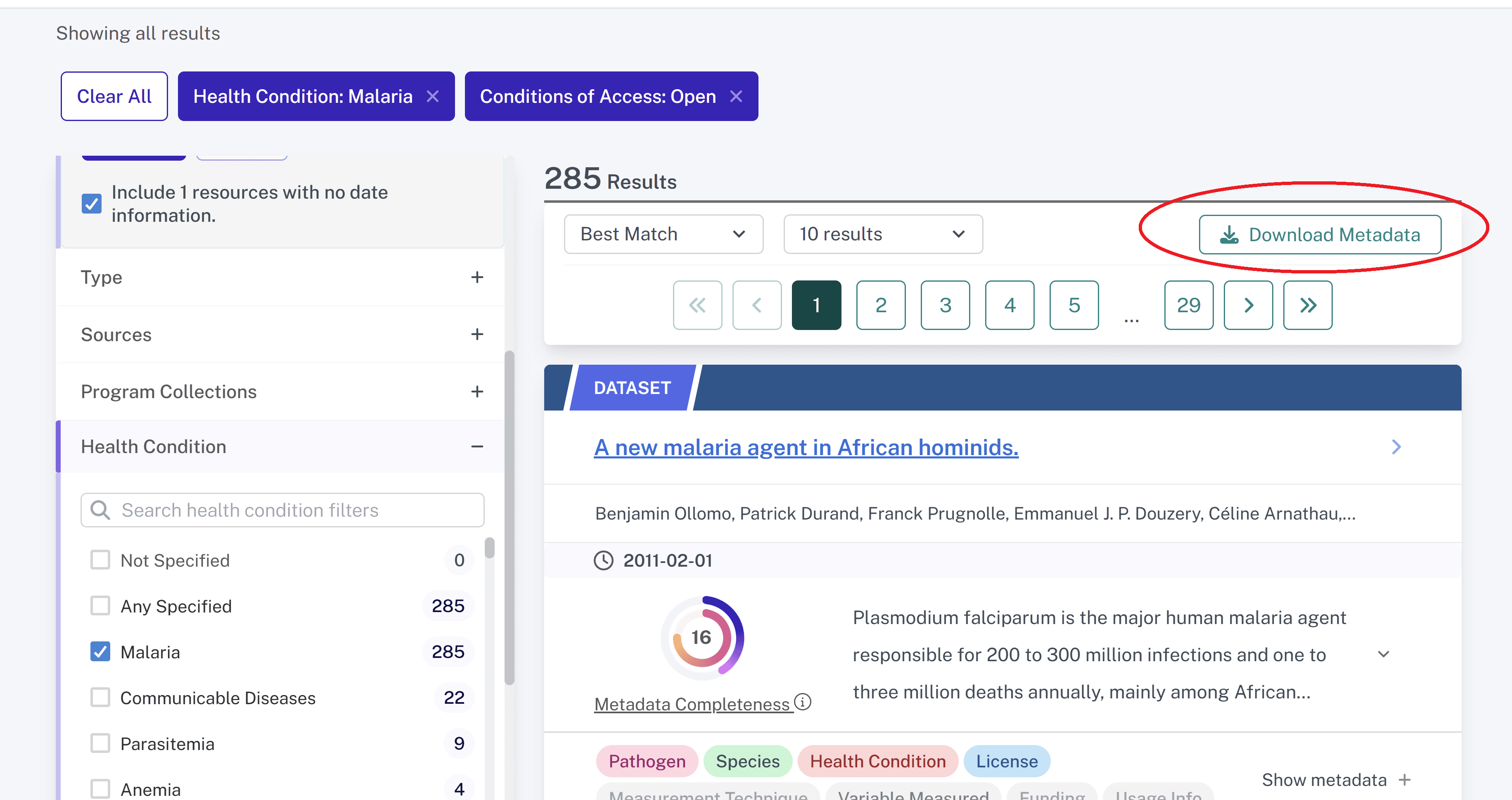
You can download metadata by using the Download Metadata button, located on the search results page.
Download all metadata:
- Leave the search bar empty and apply no filters
- Click Download Metadata to retrieve metadata for all indexed resources
Download filtered metadata:
- Enter search terms or apply filters
- Click Download Metadata to retrieve metadata only for matching results
Access Metadata via API #
Alternatively, metadata can be accessed via API at api.data.niaid.nih.gov/. See Accessing the metadata API for more information about endpoints, formats, and examples.
Keep in mind, different types of resources have some differing and some overlapping metadata fields. For example, all resources have the fields source, funding, date, etc. However, datasets have dataset-specific fields like measurement technique and variable measured, while computational tools have some relevant fields like programming language, software version, feature list, etc.
What can I do with downloaded metadata? #
- Downloading metadata from the NIAID Data Ecosystem can help you:
- Conduct large-scale meta-analyses, such as:
- Analyzing host-pathogen interaction trends by disease or species
- Comparing measurement techniques across thousands of infectious disease studies
- Tracking the evolution of research focus areas (e.g. COVID-19 variants) over time
- Track research trends by health condition, topic category, study year, or other variables
- Track research across funding programs
Last updated on